

Football has always belonged to the world. But today, the centre of gravity is shifting and fast. The Saudi Pro League growth story is no longer just a regional headline. It’s a global conversation. From blockbuster transfers to billion-dollar infrastructure projects, Saudi Arabia is reshaping what modern football investment looks like. What used to be a European-dominated ecosystem is now witnessing serious competition from the Gulf.

Across the region, football in the Middle East is evolving from passion to power. Massive soccer investments in Saudi Arabia are transforming stadiums, attracting global icons, and drawing unprecedented international attention. Behind it all sits a strategic blueprint: Saudi sports investment under Vision 2030, a long-term national transformation plan aimed at diversifying the economy beyond oil.
In short? Saudi Arabia isn’t just buying players. It’s building an ecosystem.
Saudi Arabia is investing heavily in football as part of Vision 2030 to diversify its economy, increase global influence, boost tourism, and position the Saudi Pro League as a competitive international football destination. The strategy combines infrastructure, star signings, youth development, and sovereign wealth funding to reshape global soccer dynamics.
The Rapid Growth of the Saudi Pro League
The pace of growth in the Saudi Pro League over the past three years has been nothing short of extraordinary. If you compare financial reports from 2018 to today, the numbers tell a dramatic story. Revenue streams have expanded, international broadcasting deals have multiplied, and transfer spending has placed Saudi clubs among the most aggressive buyers in global football.
Let’s start with the transfer activity. In recent seasons, Saudi football clubs collectively spent hundreds of millions of dollars during transfer windows, competing directly with Premier League and Ligue 1 clubs for elite talent. That shift alone signalled intent. The Saudi football league was no longer content with regional dominance; it wanted global recognition.
Commercially, the Saudi Pro League revenue has increased through sponsorship agreements with multinational brands, aviation partners, tech firms, and financial institutions. International broadcasting rights have expanded into Asia, Europe, and Latin America. Matches are now streamed globally, increasing exposure and advertising value.
Attendance figures have also shown upward trends, especially following high-profile signings. Stadium occupancy rates surged in Riyadh and Jeddah after the arrival of global stars. Local engagement has deepened, and matchday experiences have been modernised with digital ticketing and fan entertainment zones.
Compared to five years ago, the Saudi league has transitioned from a regionally respected competition into an emerging global contender. This growth isn’t accidental; it’s strategic, funded, and aligned with national transformation goals.
Vision 2030 and Saudi Sports Investment Strategy
At the heart of the Saudi sports investment surge lies Vision 2030. This national transformation framework is about one thing: diversification. Oil built modern Saudi Arabia, but sports,s especially football, are helping shape its future.
Government Backing and Funding
Unlike many leagues that rely purely on private ownership models, Saudi Arabia’s football expansion is deeply integrated into national economic planning. Government ministries actively support sports initiatives, seeing them as catalysts for tourism, employment, and global branding.
Public funding has accelerated infrastructure upgrades, youth academies, and event hosting capabilities. Regulatory adjustments have also encouraged foreign investment in Saudi sports entities. In other words, the state isn’t just observing growth, but it’s engineering it.
This top-down alignment ensures continuity. Projects aren’t seasonal experiments. They are long-term commitments embedded in economic policy.
Public Investment Fund (PIF) Role in Football
The Public Investment Fund (PIF) plays a central role in soccer investments in Saudi Arabia. As one of the world’s largest sovereign wealth funds, PIF has strategically acquired stakes in major Saudi clubs, injecting liquidity and governance oversight.
This involvement does three things:
- Provides financial stability
- Enables high-profile acquisitions
- Aligns club objectives with national strategy
PIF-backed clubs can compete for elite players because they deploy capital in a structured manner rather than through impulsive spending. It’s an investment with geopolitical weight.
Long-Term Sports Diversification Goals
Vision 2030’s sports pillar aims to:
- Increase sports participation among citizens
- Boost private sector contribution
- Attract international events
- Position Saudi Arabia as a global sports hub
Football is the spearhead, but the ambition is broader. Boxing, Formula 1, golf, and esports are also part of the strategy. Still, football remains the emotional and commercial anchor.
Saudi Arabia isn’t just growing a league. It’s building a sports economy.
Why Football in the Middle East Is Gaining Global Attention
For decades, Europe dominated football headlines. But today, the growth of football in the Middle East is impossible to ignore. The 2022 FIFA World Cup in Qatar changed global perceptions. It proved that the region could host world-class tournaments, manage infrastructure at scale, and deliver commercial success.
Saudi Arabia capitalised on that momentum.
Regional tournaments now receive increased media rights bids. Asian Champions League fixtures attract higher global streaming numbers. International journalists regularly cover developments in Riyadh.
Why the sudden attention?
Because investment signals seriousness.
When clubs sign global icons, global audiences follow. When stadiums rival European arenas in terms of technology and design, sceptics take notice. When sovereign funds back long-term development, the football world recalibrates.
The Middle East is no longer peripheral in global soccer; it’s becoming central.
And Saudi Arabia is leading that charge.
Big Transfers and Global Stars Moving to Saudi Arabia
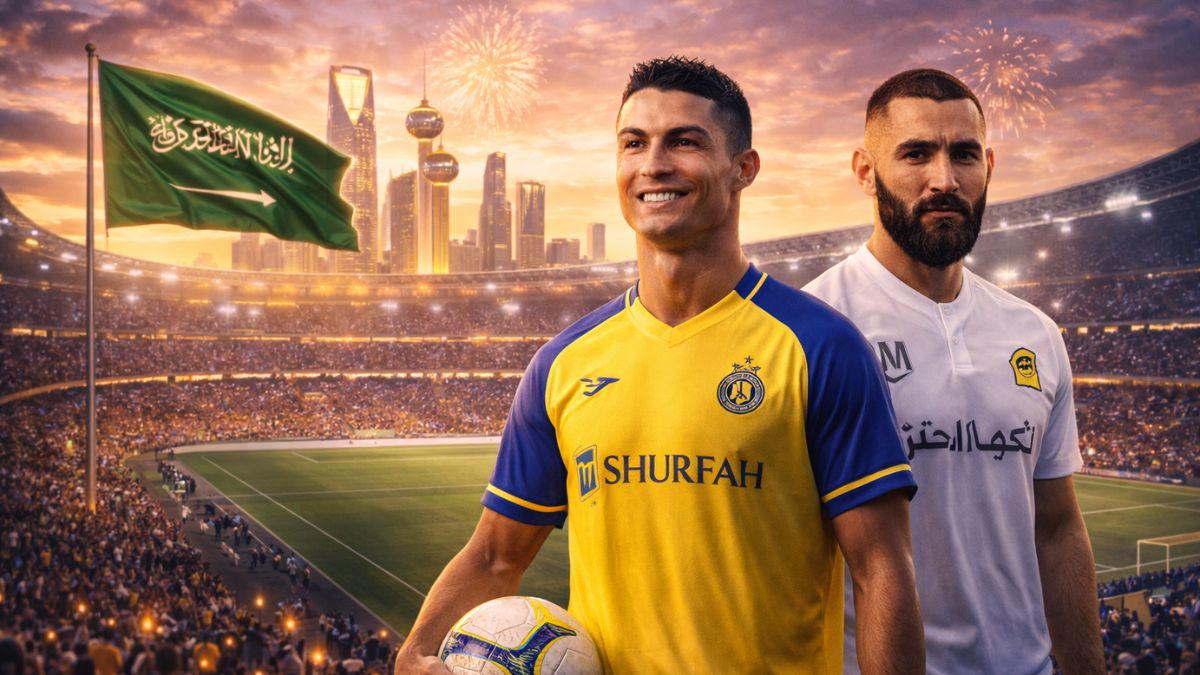
When Cristiano Ronaldo signed with Al Nassr, the global football community paused. Some were shocked. Others were sceptical. But almost everyone paid attention. That moment became a turning point in the narrative around football stars in Saudi Arabia. It wasn’t just a transfer,r it was a statement.
Since then, the Saudi Pro League has attracted high-profile names including Neymar, Karim Benzema, N’Golo Kanté, Riyad Mahrez, Sadio Mané, and others. The pattern became clear: this wasn’t a one-off marketing move. It was part of a broader plan to elevate league visibility and competitiveness.
So why are elite players making the move?
It’s not only about financial packages, though reports show some of the highest-paid footballers in Saudi Arabia earn record-breaking salaries. It’s also about legacy, brand expansion, and being part of a league in transformation. Players are stepping into ambassadorial roles for a rapidly growing football ecosystem.
Impact of Star Signings
Star players act like global megaphones. When Ronaldo posts about a match in Riyadh, hundreds of millions of followers see it. Social media engagement skyrockets. Merchandise sales increase. Sponsorship negotiations strengthen.
Clubs benefit from:
- Immediate global recognition
- Increased ticket demand
- International broadcast negotiations
- Commercial partnership leverage
It’s the ripple effect. One signing changes perception. Multiple signings reshape an entire league’s identity.
Influence on League Popularity
Before 2022, global searches for the Saudi Pro League were modest. Today, search trends show exponential spikes. International fans who previously followed only European leagues are now checking Saudi match schedules.
Streaming platforms report increased subscriptions tied to league coverage. Fan pages in Latin America, Europe, and Asia actively discuss Saudi fixtures. The league is no longer geographically limited in its audience.
And here’s the key: popularity compounds. As visibility increases, so does commercial value. That cycle fuels further growth in the Saudi Pro League.
Global Brand Expansion
Football is branding. It’s soft power. It’s international storytelling.
By attracting global stars, Saudi Arabia has expanded its football brand beyond the Gulf. The league is featured in international sports debates, transfer rumour cycles, and global sponsorship discussions.
The Saudi Pro League isn’t asking for attention anymore. It commands it.
Saudi Pro League vs European Leagues
Naturally, comparisons are inevitable. Can the Saudi Pro League compete with Europe’s elite competitions? Is the Saudi Pro League becoming a top league globally? The answer depends on what metrics you examine.
Let’s break it down.
Salary Competitiveness
In terms of player compensation, Saudi clubs are among the most competitive in the world. Some contracts surpass those in the English Premier League and La Liga.
Financial muscle has enabled rapid talent acquisition. However, long-term sustainability depends on revenue growth matching wage structures.
League Quality and Tactical Standards
European leagues still dominate in terms of historical prestige, competitive depth, and tactical refinement. Decades of academy systems and continental competitions provide maturity.
However, the Saudi league’s quality has improved significantly, with the influx of international players and coaches raising technical standards.
Global Audience Comparison
Europe retains a larger share of global TV audiences. Yet Saudi viewership is growing rapidly, particularly across Asia and Africa.
Infrastructure and Facilities
Modern Saudi stadiums and training complexes rival European facilities. Investment in sports science and recovery technology is substantial.
Comparison Table
|
Category |
Saudi Pro League |
Top European Leagues |
|
Transfer Spending |
Rapidly Increasing |
Established High |
|
Player Salaries |
Extremely Competitive |
Competitive |
|
Global Audience |
Expanding |
Massive |
|
Infrastructure |
Newly Developed |
Mature & Historic |
|
Commercial Revenue |
Growing |
Highly Diversified |
The gap isn’t closing, but it’s narrowing faster than many expected.
Stadiums and Football Infrastructure Development
If players are the headline, infrastructure is the foundation. And Saudi Arabia is investing heavily in both.
Major Saudi stadium projects are reshaping skylines. Riyadh and Jeddah are home to modern arenas equipped with advanced cooling systems, retractable roofs, and smart crowd management technology. These facilities are designed not just for domestic matches but for global tournaments.
Beyond stadiums, elite training complexes are being developed with cutting-edge sports science laboratories. Clubs now offer recovery pools, performance analytics suites, and AI-driven match analysis tools.
This isn’t cosmetic spending. Infrastructure defines long-term competitiveness.
Key developments include:
- Expansion of King Fahd International Stadium
- New multi-purpose arenas aligned with World Cup standards
- Youth training academies linked to European technical partnerships
Infrastructure also boosts tourism. International fans visiting Saudi Arabia experience world-class venues comparable to London or Madrid.
Investment in football infrastructure in Saudi Arabia ensures that the league’s growth is sustainable, not superficial.
Youth Development and the Future of Football in Saudi Arabia
Signing global stars creates headlines. Developing local talent creates a legacy.
Saudi Arabia understands that sustainable success requires strong grassroots foundations. That’s why Saudi football youth development programs are expanding rapidly.
Academies across the kingdom now integrate European coaching methodologies. Partnerships with international clubs provide technical expertise. Young players are being scouted earlier, trained more intelligently, and supported by advanced sports science.
The national team strategy is equally ambitious. After Saudi Arabia’s stunning victory over Argentina in the 2022 World Cup group stage, confidence surged. That moment wasn’t luck; it reflected structural improvement.
Long-term goals include:
- Producing world-class Saudi players
- Increasing youth participation rates
- Strengthening domestic league depth
- Competing consistently in international tournaments
The future of football in Saudi Arabia depends on this talent pipeline. Imports may accelerate growth, but homegrown excellence sustains it.
The ambition is clear: build a league that develops stars, not just buys them.
Economic Impact of Football Investment
Follow the money, and you’ll understand the strategy.
The impact of Saudi football investment extends beyond matchday revenue. It influences hospitality, aviation, retail, media, and employment sectors.
Job Creation and Private Sector Growth
From stadium construction to event management, thousands of jobs have been created. Marketing agencies, security firms, and digital platforms all benefit.
Football Tourism
International fans travel to attend matches featuring global icons. Hotel occupancy rises. Airlines expand routes. Restaurants and retail outlets experience increased demand.
Sponsorship and Broadcasting Revenue
Corporate sponsorship deals tied to the Saudi Pro League have grown significantly. Broadcasting rights agreements extend into multiple continents.
Football is no longer just a sport, it’s an economic engine.
Within the broader Gulf economy, Saudi Arabia’s football expansion positions it as a regional leader in sports commercialization.
Saudi Arabia’s Global Football Ambitions
Saudi Arabia isn’t thinking small.
The kingdom has expressed intentions around hosting major international tournaments, including a potential Saudi World Cup bid. Infrastructure alignment and regulatory reforms reflect this ambition.
Hosting international competitions enhances diplomatic visibility, tourism, and foreign investment.
Strategic partnerships with global football organisations further strengthen credibility. Collaborations with FIFA-linked programs and European clubs signal integration, not isolation.
Saudi football development is about influence. It’s about being at the table where global football decisions are made.
Challenges and Criticism of Saudi Football Expansion
Rapid growth always invites scrutiny.
Critics question financial sustainability. Can spending levels remain consistent long-term? Will revenue growth keep pace with wage structures?
Others raise concerns about competitive balance. If a few PIF-backed clubs dominate financially, parity may suffer.
International perception also plays a role. Global media narratives influence brand positioning.
These challenges are real but not unique. Every emerging league faces similar questions.
Addressing sustainability through diversified revenue streams and youth development will determine long-term credibility.
What the Future Holds for Saudi Football
Project five years forward.
If current trends continue, the Saudi Pro League’s growth suggests increased global competitiveness, stronger domestic talent, and expanded commercial reach.
Within ten years, Saudi Arabia could:
- Rank among the top global leagues in revenue
- Host major FIFA tournaments
- Produce internationally recognised Saudi superstars
- Become the Middle East’s undisputed football hub
Momentum matters. And right now, momentum favours Saudi football.
The transformation is not a short sprint. It’s a marathon backed by strategy, capital, and national vision.
Conclusion
Saudi Arabia’s rise in global football isn’t accidental. It’s calculated, funded, and strategically aligned with Vision 2030. The Saudi Pro League’s growth story goes beyond star transfers; it reflects economic diversification, geopolitical positioning, and long-term sports development.
Whether you see it as disruption or evolution, one thing is clear: football’s map is being redrawn. And Saudi Arabia is placing itself firmly at the centre.

Ryan Mitchell explores the intersection of sports, business, and investment in the Gulf region. From major sporting events to sponsorship deals and infrastructure investments, his work highlights how sports are becoming a key economic driver. He provides a unique perspective on the business side of the region’s growing sports industry.