

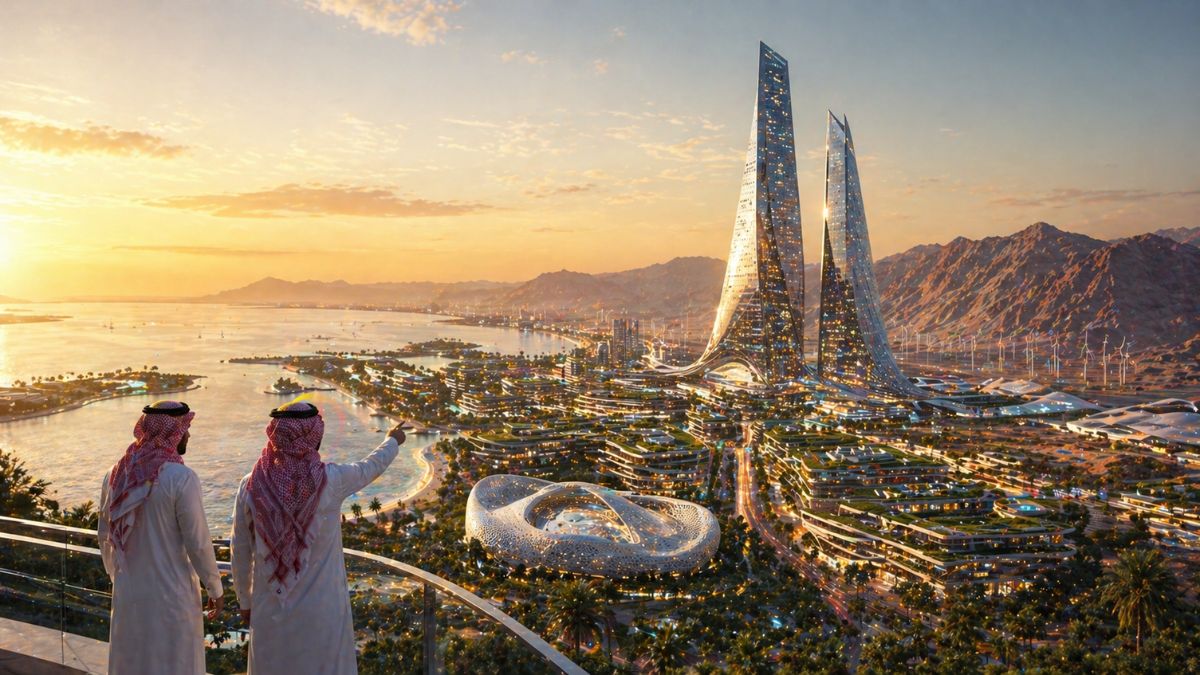

The NEOM project in Saudi Arabia is not just another infrastructure development. It’s one of the most ambitious urban experiments in modern history. Rising from the northwestern deserts along the Red Sea, NEOM is designed to redefine how cities function, how economies diversify, and how sustainability integrates with technology.
Global investors, sovereign wealth funds, tech companies, and real estate developers are closely watching NEOM’s investment, seeing it as a centrepiece of major Saudi megaprojects under Vision 2030. From futuristic architecture to renewable energy leadership, NEOM City’s future represents far more than buildings; it represents a strategic economic shift.
More Read

What Is the NEOM Project in Saudi Arabia?
To understand the hype, you need to understand the scale.
The NEOM city project in Saudi Arabia is a planned megacity spanning approximately 26,500 square kilometres in the Tabuk province, near the Red Sea. That makes it larger than some small countries. Positioned strategically near Egypt and Jordan, NEOM sits at a global trade crossroads linking Asia, Europe, and Africa.
So, what is NEOM Saudi Arabia aiming to be?
It’s envisioned as a smart, sustainable, AI-driven urban ecosystem powered entirely by renewable energy. Unlike traditional cities that expand outward, NEOM proposes revolutionary layouts and infrastructure models designed to eliminate congestion, pollution, and inefficient zoning.
The NEOM Saudi Arabia project details include:
- 100% renewable energy operations
- AI-powered governance systems
- Zero-carbon emissions targets
- Advanced manufacturing and logistics hubs
- Luxury tourism and lifestyle zones
Financially, estimates suggest hundreds of billions of dollars are allocated to development. The project is backed by Saudi Arabia’s Public Investment Fund (PIF), one of the world’s largest sovereign wealth funds.
But NEOM isn’t just a city, it’s a strategic pillar of national transformation under Vision 2030.
NEOM and Saudi Vision 2030 Strategy
At its core, NEOM is about economic diversification.
For decades, Saudi Arabia’s economy has relied heavily on oil exports. Through Saudi Vision 2030 projects, the Kingdom aims to reduce oil dependency and create alternative revenue streams in tourism, technology, renewable energy, logistics, and advanced manufacturing.
NEOM plays a central role in this transition.
By building a new economic zone from scratch, Saudi Arabia can implement:
- Modern regulatory frameworks
- Foreign investor-friendly policies
- Advanced digital infrastructure
- Sustainable urban planning models
The broader goal? Transform Saudi Arabia into a new economic hub for the Middle East and beyond.
Vision 2030 investment projects aim to attract foreign direct investment (FDI), boost private-sector participation, and increase the contribution of non-oil industries to GDP.
NEOM serves as the flagship demonstration of that ambition.
Instead of retrofitting existing cities, Saudi Arabia is creating an entirely new ecosystem purpose-built for the future economy.
The Key Components of NEOM
NEOM isn’t a single project. It’s a portfolio of interconnected developments.
The Line – The Linear Smart City
Perhaps the most talked-about element is The Line NEOM. Unlike traditional cities, The Line is designed as a 170-kilometre linear urban corridor with no cars, roads, or emissions.
Residents would have access to all essential services within a five-minute walk. High-speed transit would connect end-to-end travel in under 20 minutes.
Key features include:
- Vertical city design
- AI-driven urban management
- 100% renewable energy
- High-density, low-footprint architecture
This concept positions The Line among the most ambitious smart cities in Saudi Arabia, potentially setting a global benchmark for sustainable urban living.
Oxagon – Industrial & Innovation Hub
Oxagon NEOM focuses on advanced manufacturing, green energy, and logistics. It aims to become one of the world’s largest floating industrial complexes.
Central to Oxagon’s strategy is the hydrogen project NEOM, which aims to produce large-scale green hydrogen powered by renewable energy.
This positions NEOM as a leader in clean-energy exports, aligning with global decarbonization trends.
For investors in infrastructure and energy, Oxagon represents a massive opportunity.
Trojena – Mountain Tourism Project
Trojena NEOM introduces something unexpected: a mountain tourism destination featuring outdoor sports, wellness resorts, and even winter activities.
Saudi Arabia tourism investment is accelerating, and Trojena aims to attract global visitors seeking unique experiences in a region not traditionally associated with alpine landscapes.
It demonstrates NEOM’s diversification across sectors, industry, lifestyle, and tourism.
Why Investors Are Interested in NEOM
When you strip away the futuristic renderings and bold headlines, the real question is simple: why are serious investors committing capital to the NEOM project in Saudi Arabia?
First, scale. Few global projects match NEOM’s ambition. Investors are drawn to large, transformative developments because they create entire ecosystems, housing, transport, energy, logistics, tourism, and technology, all interconnected. That means multiple entry points for investment in NEOM, from venture capital in tech startups to infrastructure bonds and real estate funds.
Second, government backing. NEOM isn’t a private speculative development. It’s supported by Saudi Arabia’s Public Investment Fund (PIF), providing institutional credibility. That reduces perceived political risk and signals long-term commitment.
Third, geographic positioning. NEOM sits along major global shipping routes, near the Suez Canal corridor. Companies focused on logistics, advanced manufacturing, and global trade see strategic value in early positioning.
Fourth, policy reform. Saudi Arabia has introduced investor-friendly regulations, special economic zone incentives, and simplified foreign ownership frameworks. This encourages foreign investment in NEOM, particularly from Europe, Asia, and North America.
Finally, timing. Investors often seek first-mover advantage. Being early in a mega development can generate long-term appreciation as infrastructure matures.
In short, NEOM isn’t just attracting speculative interest; it’s attracting institutional capital seeking strategic exposure to the next major Middle Eastern economic hub.
NEOM Real Estate Investment Opportunities
Real estate sits at the heart of any megacity. In NEOM’s case, NEOM real estate investment is one of the most anticipated segments of the entire development.
Unlike traditional property markets, NEOM offers something unique: the opportunity to invest in a city being built from the ground up with smart infrastructure integrated from day one.
Potential segments include:
- High-end residential communities
- Smart apartment complexes
- Commercial office districts
- Innovation parks
- Luxury tourism resorts
The future property in NEOM is designed around sustainability, connectivity, and automation. Smart homes powered by AI systems, zero-carbon buildings, and energy-efficient designs are expected to become the norm.
For institutional investors, large-scale mixed-use developments may offer strong long-term capital appreciation. For individual investors, once regulations allow broader participation, early entry could resemble investing in Dubai during its early expansion years.
Luxury real estate projects in NEOM, especially in Trojena and coastal zones, are expected to target high-net-worth individuals and global investors seeking exclusive assets.
However, as with any emerging property market, long-term value depends on successful execution, population growth, and sustained economic activity.
Funding and Financial Backing
No project of this magnitude moves forward without massive funding.
The NEOM Public Investment Fund (PIF) plays a central role. PIF is one of the world’s largest sovereign wealth funds, managing hundreds of billions of dollars in assets. It’s a sign of financial muscle and long-term commitment.
NEOM funding sources include:
- Direct PIF capital allocation
- Strategic global partnerships
- Infrastructure investment in Saudi Arabia programs
- Private sector participation
International companies investing in NEOM include engineering firms, renewable energy providers, and technology giants.
Public-private partnerships are expected to play a major role in delivering infrastructure, utilities, and transportation systems.
Projected total investment over time is estimated in the hundreds of billions, positioning NEOM among the most capital-intensive Saudi Arabia investment projects ever launched.
For investors, the combination of sovereign backing and international collaboration reduces uncertainty while maintaining upside potential.
Technology and Innovation at the Core of NEOM
If there’s one theme that defines NEOM, it’s technology.
The city aims to embed AI in NEOM governance systems, energy grids, healthcare delivery, and transportation networks. Instead of retrofitting smart systems into old infrastructure, NEOM plans to integrate digital architecture from the start.
Key innovation pillars include:
- Artificial intelligence for urban management
- Autonomous public transportation
- Drone-based logistics systems
- Smart energy grids
- Advanced water desalination technologies
Renewable energy is central. NEOM targets 100% renewable power generation, including large-scale solar and wind installations. The green hydrogen project NEOM aims to position Saudi Arabia as a global exporter of clean energy.
For tech investors, NEOM represents a large-scale sandbox for innovation, a place where new technologies can be tested and deployed at an urban scale.
It’s often described as a futuristic city in the Middle East, but the real story is economic: technology is being used as a catalyst for long-term diversification.
How NEOM Compares to Other Saudi Megaprojects
Saudi Arabia isn’t building just one megaproject. It’s launching multiple giga developments simultaneously.
Here’s how NEOM compares to other major Saudi megaprojects:
|
Project |
Focus |
Investment Scale |
Timeline |
|
NEOM |
Smart city, industry, tourism |
Hundreds of billions USD |
Phased through 2030+ |
|
Red Sea Project |
Luxury tourism |
Multi-billion USD |
Phased completion 2030 |
|
Qiddiya |
Entertainment & sports |
Multi-billion USD |
Ongoing |
|
Diriyah Gate |
Cultural heritage & tourism |
Multi-billion USD |
Ongoing |
Among all Saudi giga projects, NEOM stands out for its scale, technological ambition, and integrated economic design.
While projects like the Red Sea focus primarily on tourism, NEOM spans industry, technology, logistics, energy, and lifestyle, making it structurally more diversified.
Economic Impact of NEOM on Saudi Arabia
The economic implications are significant.
Analysts project that NEOM could contribute substantially to the national GDP once operational. The NEOM GDP contribution is expected to grow through job creation, export revenue, and foreign direct investment.
Key economic benefits include:
- Hundreds of thousands of jobs
- Increased FDI inflows
- Expansion of non-oil revenue streams
- Tourism sector growth
By positioning itself as a new economic hub in Saudi Arabia, NEOM could attract multinational corporations seeking regional headquarters.
The broader Middle East infrastructure boom also benefits from NEOM’s supply chain demand engineering, construction, logistics, and services sectors across the region, which see spillover effects.
In macroeconomic terms, NEOM is both a symbol and a driver of Saudi Arabia’s transformation strategy.
Timeline and Construction Progress
Large-scale developments require phased execution.
The NEOM construction progress has already moved through early infrastructure groundwork, utility planning, and initial building phases.
Key milestones include:
- Launch announcements under Vision 2030
- Infrastructure groundwork and site preparation
- Green hydrogen project agreements
- Early-stage construction of The Line
The full timeline for NEOM completion extends beyond 2030, with phased delivery of residential, industrial, and tourism components.
Major cities aren’t built overnight. Investors evaluating NEOM must think in decades, not quarters.
Challenges and Risks Facing the NEOM Project
No megaproject is risk-free.
The primary challenges facing the NEOM project include:
- Enormous capital requirements
- Engineering complexity
- Environmental sustainability targets
- Long-term population attraction
Execution risk is real. Building a city from scratch requires coordination across technology, infrastructure, governance, and global supply chains.
Questions like “Is NEOM a good investment?” depend partly on long-term political stability, global economic cycles, and the successful delivery of promised innovation.
Balanced analysis is essential. High ambition brings high complexity.
Is NEOM a Good Investment?
From a strategic standpoint, investment in NEOM represents exposure to long-term transformation rather than short-term returns.
Pros:
- Strong sovereign backing
- Alignment with Vision 2030
- Global strategic location
- Multi-sector diversification
Risks:
- Extended timelines
- Capital intensity
- Market adoption uncertainty
For institutional investors with long horizons, NEOM may offer compelling opportunities. For private investors, participation may depend on access to regulations and risk tolerance.
The future of NEOM city will determine ultimate returns, but early positioning often yields outsized rewards.
The Future of NEOM City
Looking ahead 5-10 years, NEOM aims to transition from blueprint to operational ecosystem.
Expected developments include:
- Operational industrial zones in Oxagon
- Tourism openings in Trojena
- Early residential occupancy in The Line
- Expansion of global corporate partnerships
As NEOM global partnerships grow, international confidence may strengthen.
If execution aligns with its vision, NEOM could redefine global urban planning standards.
If delays occur, timelines may shift, but the broader transformation narrative remains intact.
Either way, NEOM represents one of the boldest urban experiments of the 21st century.
Conclusion
The NEOM project in Saudi Arabia is more than a construction initiative; it is a strategic reimagining of economic development, sustainability, and urban life.
Investors are betting big because NEOM combines sovereign backing, technological ambition, geographic advantage, and alignment with Vision 2030 into a single transformative vision.
While risks exist as they do with any project of this scale, the long-term potential continues to attract global capital.
In a world searching for the next great economic frontier, NEOM is among the most closely watched opportunities in the Middle East.

