

Dubai has transformed itself into one of the world’s most powerful luxury real estate destinations. What was once a desert trading port is now home to some of the most expensive properties in Dubai, attracting billionaires, global celebrities, hedge fund managers, crypto entrepreneurs, and multinational investors. The market for luxury homes in Dubai has surged over the past few years, with record-breaking transactions reshaping global property rankings.
From waterfront Dubai mansions on Palm Jumeirah to sky-high penthouses overlooking the Burj Khalifa, high-end real estate in the UAE competes directly with London, New York, Monaco, and Hong Kong. The difference? Tax efficiency, security, and lifestyle appeal that few cities can match.
Dubai isn’t just selling square footage. It’s selling a lifestyle with private beaches, yacht moorings, skyline views, and global connectivity.
More Read

Why Dubai Is a Global Luxury Real Estate Hub
The Dubai luxury property market didn’t become dominant by accident. It evolved strategically. Over the past decade, especially since 2020, the city has positioned itself as a haven for global wealth.
First, taxation. Dubai offers zero personal income tax and no capital gains tax on property. For high-net-worth individuals relocating from heavily taxed jurisdictions, this alone can significantly alter investment decisions. Luxury real estate in Dubai, therefore, becomes both a lifestyle purchase and a wealth-preservation tool.
Second, wealth migration. Political and economic uncertainty in parts of Europe, Asia, and emerging markets has driven affluent families toward stable jurisdictions. Dubai’s residency options, combined with the strict rule of law and investor-friendly policies, created a magnet effect. Ultra luxury homes in Dubai are increasingly purchased by global buyers seeking asset diversification.
Third, safety and infrastructure. Dubai consistently ranks among the world’s safest cities. For families and investors alike, security matters. Add world-class healthcare, international schools, luxury retail, Michelin-star restaurants, and global air connectivity through Emirates Airlines, and the appeal becomes obvious.
Fourth, strategic geography. Dubai sits at the crossroads of Europe, Asia, and Africa. For entrepreneurs managing international portfolios, it’s a practical base.
The Dubai property boom of recent years reflects the convergence of all these forces. And unlike short-term speculative cycles, this boom is driven by structural demand, long-term wealth relocation,n and capital inflows.
Overview of Dubai’s Luxury Property Market
The numbers tell a compelling story. Dubai luxury property prices in prime waterfront and ultra-prime areas now rival global capitals. In Palm Jumeirah, ultra-luxury villas can exceed AED 50-100 million, with select trophy estates crossing AED 300 million.
Average price per square foot in prime waterfront zones has surged significantly over the past few years. High-end real estate in the UAE, particularly in the ultra-prime segment (above AED 30 million), has seen double-digit annual growth in certain neighbourhoods.
Record-breaking transactions have made headlines:
- Villas selling for over AED 400 million
- Penthouse deals exceeding AED 150 million.
- Multiple transactions above AED 100 million in a single quarter
Luxury property demand in Dubai remains heavily international. Buyers originate from Europe, Russia, India, China, Africa, the UK, and increasingly North America. Crypto wealth has also entered the market aggressively.
Dubai real estate trends 2026 projections suggest continued resilience, particularly in the ultra-prime category, where supply is limited. Unlike mid-market developments, trophy assets, such as beachfront mansions, private island villas, and branded penthouses, remain scarce.
This scarcity is precisely what sustains price strength.
Most Expensive Luxury Homes in Dubai
Dubai’s most expensive properties are concentrated in a handful of ultra-prime neighbourhoods. These areas combine exclusivity, architectural prestige, and limited supply.
Ultra-prime properties typically feature:
- Private beaches or waterfront access
- Custom-built architecture
- Smart home integration
- Private cinemas, spas, and yacht berths
- Gated community security
Let’s explore the neighbourhoods that define the top tier of luxury homes in Dubai.
Palm Jumeirah – Waterfront Billionaire Villas
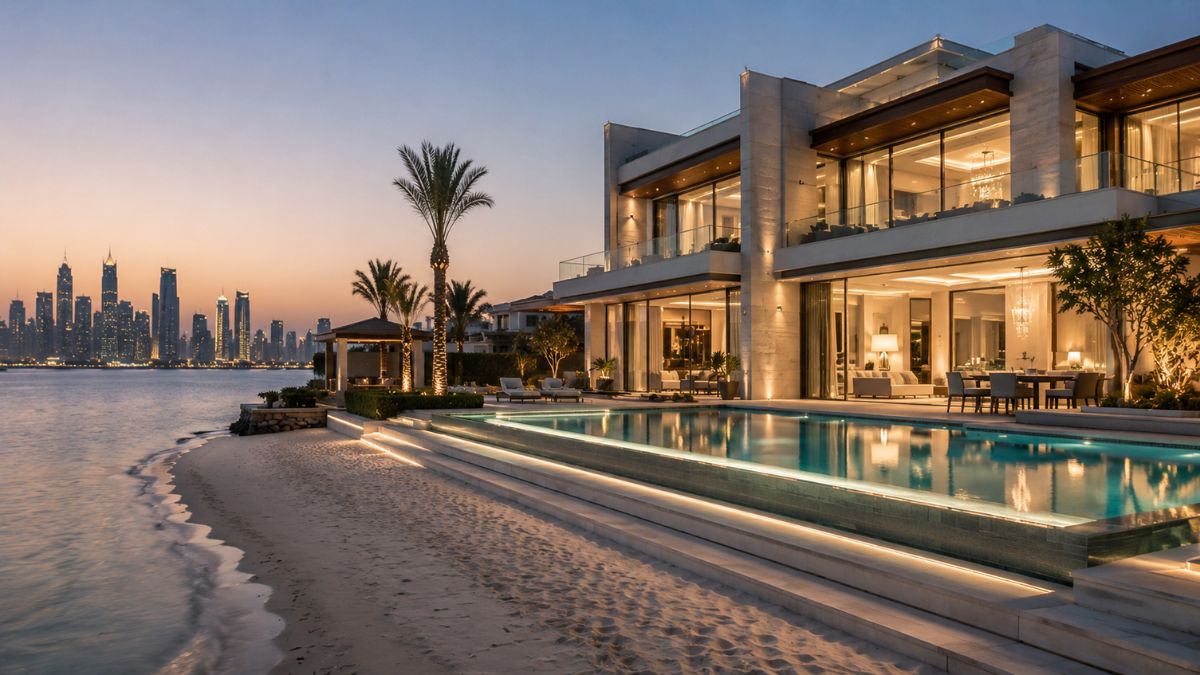
Palm Jumeirah luxury homes sit at the very top of Dubai’s property hierarchy. The artificial island, shaped like a palm tree, is globally recognisable and has hosted some of the most expensive villa transactions ever recorded.
Waterfront villas on Dubai’s Palm Jumeirah offer private beach access, skyline views, and yacht-docking facilities. Prices range broadly:
- Entry-level luxury villas: AED 30-50 million
- Ultra-prime custom mansions: AED 80-200+ million
- Record-breaking estates: Exceeding AED 300 million
Architectural styles vary from ultra-modern glass façades to Mediterranean-inspired estates. Many villas are fully bespoke, redesigned by international architects.
Celebrity ownership adds prestige. Global footballers, hedge fund founders, and tech entrepreneurs have all acquired properties here. Palm Jumeirah isn’t just a location, it’s a statement.
Scarcity plays a critical role. There are only so many beachfront plots available. As demand continues to rise, supply constraints support the long-term capital appreciation of luxury property in Dubai.
For global HNWIs, Palm Jumeirah represents Dubai’s equivalent of Malibu or Monaco waterfront exclusivity in a tax-efficient jurisdiction.
Emirates Hills – Dubai’s “Beverly Hills”
If Palm Jumeirah represents waterfront opulence, Emirates Hills mansions represent old-money prestige. Often called Dubai’s “Beverly Hills,” this gated community has long been home to billionaires, industrialists, and ultra-high-net-worth families who value privacy over publicity.
Unlike the uniformity seen in some master-planned developments, Emirates Hills offers fully custom-built estates. Plot sizes are expansive, often ranging from 15,000 to over 40,000 square feet. Many homes exceed 20,000 square feet of built-up area, featuring grand staircases, imported marble, private elevators, underground parking galleries, and resort-style gardens overlooking the Montgomerie Golf Course.
Prices reflect that exclusivity:
- Standard luxury mansions: AED 40-70 million
- Ultra-custom estates: AED 80-150 million
- Trophy compounds: Crossing AED 200 million
What sets Emirates Hills apart from other ultra-luxury communities in Dubai is its maturity. Landscaping is established. Trees are fully grown. Streets feel private and insulated. This is generational wealth territory.
Ultra-high-net-worth buyers in Dubai often choose Emirates Hills for discretion. Unlike high-profile waterfront villas that attract media attention, many transactions here happen quietly through private networks and family offices.
Security is tight. Community access is restricted. And the neighbourhood’s reputation ensures sustained demand among billionaires’ homes in Dubai.
For investors, Emirates Hills offers stability. Limited land availability and long-term ownership patterns mean resale inventory is relatively constrained, supporting price resilience even during broader market cycles.
Downtown Dubai – Sky-High Luxury Penthouses
While villas dominate the ultra-prime villa segment, Downtown Dubai penthouses command attention in the vertical luxury category. Overlooking the Burj Khalifa and Dubai Fountain, luxury penthouses in Dubai’s central district combine skyline prestige with a walkable urban lifestyle.
In buildings like the Burj Khalifa, Il Primo, Opera Grand, and Address Residences, penthouses can range between AED 40 million to well over AED 150 million, depending on size, view, and customisation.
Premium property in Dubai Downtown offers:
- Panoramic city and sea views
- Double-height ceilings
- Private elevators
- Rooftop terraces with pools
- Concierge and five-star hotel services
These properties appeal to global executives and investors who prefer central access over suburban privacy. Being steps away from the Dubai Mall, Michelin-star restaurants, and cultural venues adds intangible lifestyle value.
From an investment perspective, Downtown’s rental market is also strong. High-end furnished penthouses can generate premium rents during peak seasons and major events. While yields in ultra-prime categories are typically lower than mid-market units, they are supported by consistent international demand.
Downtown Dubai represents vertical wealth, an address that signals status globally. For buyers comparing London’s Mayfair or New York’s Billionaires’ Row, Dubai offers comparable luxury at often more competitive price-per-square-foot levels.
Jumeirah Bay Island – Private Island Living
Jumeirah Bay Island property sits in a category of its own. Shaped like a seahorse and connected by a private bridge to Jumeirah, this ultra-exclusive island hosts some of the rarest Dubai private island homes available.
Inventory here is extremely limited. That scarcity alone has driven prices sharply upward over the past few years.
Typical pricing includes:
- Premium plots: AED 40-80 million
- Completed luxury villas: AED 70-150 million
- Bulgari-branded mansions: Often exceeding AED 200 million
The island is home to Bulgari Resort & Residences, making Bulgari Residences in Dubai among the most prestigious branded luxury residences in the UAE.
What makes Jumeirah Bay Island unique is privacy. Unlike Palm Jumeirah, where tourism and residential zones coexist, Jumeirah Bay feels more secluded. Residents enjoy private marina access, curated landscaping, and low-density planning.
For ultra-high-net-worth buyers seeking exclusivity without compromise, this is Dubai’s closest equivalent to private island enclaves found in the Mediterranean or Caribbean, yet positioned in a global financial hub.
Long-term investment appeal remains strong due to limited supply and consistently high demand from ultra-high-net-worth buyers in Dubai.
Dubai Hills Estate – Golf Community Mansions
Dubai Hills Estate luxury villas combine modern architecture with green spaces, a rare combination in major global cities. Centred around an 18-hole championship golf course, this master-planned community offers contemporary mansions designed for family living.
Luxury golf community buyers in Dubai typically include entrepreneurs, corporate executives, and affluent expats seeking both privacy and proximity to Downtown.
Price ranges generally include:
- Luxury villas: AED 20-40 million
- Ultra-modern mansions: AED 50-100 million
Dubai Hills differs from Emirates Hills in architectural style. While Emirates Hills often features classical European designs, Dubai Hills leans towards modern glass façades, open-plan interiors, and minimalist aesthetics.
The community also integrates:
- International schools
- Dubai Hills Mall
- Hospitals and healthcare facilities
- Parks and cycling tracks
For families relocating under the Golden Visa property programs, Dubai Hills offers a high level of lifestyle convenience.
From an investment perspective, Dubai Hills has shown strong capital appreciation amid luxury property growth in Dubai, driven by infrastructure maturity and growing global brand recognition.
Branded Residences & Designer Luxury Homes
Branded residences in Dubai have become a defining feature of the high-end real estate market in the UAE. Global luxury brands such as Armani, Bulgari, and the Dorchester Collection have partnered with developers to create designer homes that blend fashion, hospitality, and architecture.
Armani Residences Dubai, inside the Burj Khalifa, exemplifies this model. Interiors are curated by Giorgio Armani himself, offering minimalist elegance aligned with the brand’s identity.
Bulgari Residences Dubai on Jumeirah Bay Island reflects Italian coastal sophistication. Materials, finishes, and amenities are curated to luxury hotel standards.
Why do branded luxury residences in the UAE command premiums?
- Brand recognition
- Hospitality-level service
- Design exclusivity
- Global resale appeal
For international buyers unfamiliar with regional developers, brand partnerships offer a sense of trust and familiarity. That trust translates into investment appeal and price resilience.
Branded residences are particularly attractive to global HNWIs who own multiple properties worldwide and seek consistency in service and design standards.
Who Is Buying Dubai’s Most Expensive Homes?
Ultra-high-net-worth Dubai real estate buyers are increasingly diverse. Historically dominated by regional investors, the market now includes European entrepreneurs, Russian billionaires, Indian industrialists, Chinese investors, British financiers, African business magnates, and American tech founders.
Dubai property for HNWI buyers often involves private family offices conducting discreet transactions. Many deals occur off-market, especially for properties valued at over AED 100 million.
Crypto wealth has also influenced purchases of million-dollar homes in Dubai. Dubai’s regulatory openness to digital assets has attracted blockchain entrepreneurs seeking both residency and investment opportunities.
Another growing segment includes global hedge fund managers relocating from traditional financial centres. With zero income tax and strong connectivity, Dubai becomes operationally attractive.
The buyer profile is increasingly strategic rather than speculative. Many purchasers plan long-term residency, second-home usage, or wealth preservation rather than short-term flipping.
Investment Potential of Luxury Property in Dubai
Luxury property investment in Dubai continues to outperform many global peers, particularly in the ultra-prime segment.
Capital Appreciation Trends
Over recent years, luxury homes on Palm Jumeirah and properties on Jumeirah Bay Island have recorded double-digit annual price growth during peak periods. Limited supply and rising global wealth migration underpin appreciation.
Rental Yield for Luxury Homes
While ultra-prime villas typically yield lower percentages (2-4%), premium penthouses and branded apartments can achieve stronger returns during peak demand seasons. Corporate leases and diplomatic tenants add stability.
Long-Term ROI
Is Dubai luxury property a good investment? For many HNWIs, the answer lies in a mix of capital growth, currency diversification, tax efficiency, and lifestyle utility.
Below is a simplified comparison:
Area | Avg Price (AED) | Price Growth Trend | Buyer Type |
Palm Jumeirah | 40M-200M+ | High (limited supply) | Global UHNWIs |
Emirates Hills | 50M-150M+ | Stable, steady | Family offices |
Downtown Dubai | 30M-150M | Moderate-high | Executives, investors |
Jumeirah Bay | 70M-200M+ | Very high (scarce) | Billionaires |
Dubai Hills | 20M-100M | Growing | Affluent families |
Foreign Ownership & Golden Visa Benefits
Can foreigners buy luxury property in Dubai? Yes. Freehold luxury properties in Dubai are allowed full ownership in designated zones, including Palm Jumeirah, Downtown, Dubai Hills, and Jumeirah Bay Island.
Golden Visa property thresholds in Dubai start at qualifying property investments (subject to regulatory updates). Dubai residency through property offers long-term residency benefits, including:
- Multi-year renewable visas
- Family sponsorship
- Business operation flexibility
For global investors, this residency stability enhances the property’s attractiveness.
Smart Homes & Future Luxury Trends
Smart homes, Dubai luxury buyers now expect AI-integrated systems that control lighting, climate, security, and entertainment. Voice-command automation and biometric access are increasingly standard in ultra-luxury homes in Dubai.
Eco-luxury homes in UAE developments incorporate solar panels, energy-efficient glazing, water-recycling systems, and sustainable materials.
Dubai luxury lifestyle continues evolving toward:
- Private wellness centres
- In-home spas
- Yacht integration
- Sustainable waterfront engineering
Future luxury isn’t just bigger, it’s smarter and greener.
Risks & Market Considerations
Dubai property market forecast: Luxury projections remain positive, but no market is immune to cycles.
Considerations include:
- Global interest rate shifts
- Geopolitical influences
- Supply expansion in non-prime segments
Luxury property demand in Dubai in ultra-prime areas tends to be more resilient due to scarcity and wealth concentration. However, mid-tier oversupply can influence broader sentiment.
A balanced investment strategy requires understanding market timing and asset quality.
The Future of Dubai’s Ultra-Luxury Market
The Dubai luxury property market appears positioned for continued strength over the next five years. Mega projects, infrastructure expansion, and inflows of global wealth support long-term growth.
The most expensive properties in Dubai will likely continue to set regional records, particularly in limited-supply areas like Jumeirah Bay and Palm Jumeirah.
Dubai property boom conditions may moderate, but structural drivers, such as tax efficiency, safety, and global connectivity, remain intact.
For HNWIs, Dubai has evolved from an opportunistic market into a strategic allocation in global real estate.
Conclusion
Luxury homes in Dubai represent more than high-end real estate in the UAE; they symbolise wealth mobility, global lifestyle positioning, and strategic investment. From Dubai mansions on Palm Jumeirah to branded penthouses in Downtown, the city has cemented itself as a premier ultra-luxury destination. With continued global demand and limited trophy supply, Dubai’s most expensive properties remain at the forefront of international wealth estate portfolios. for the wealthy.