

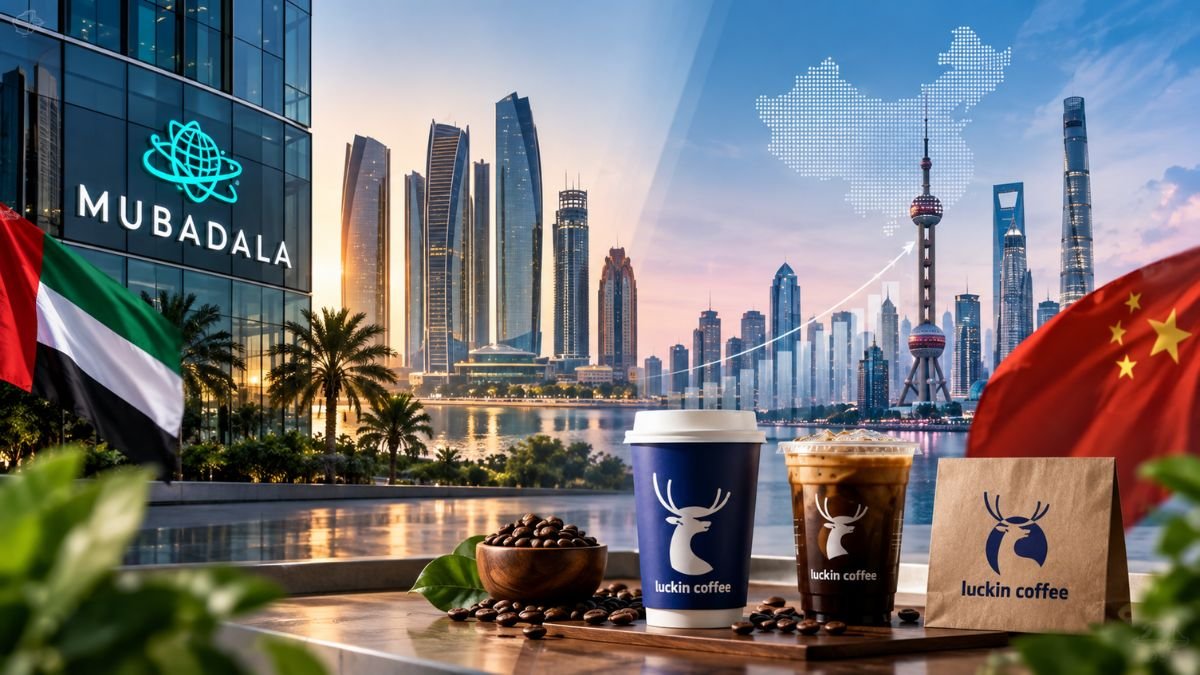
Abu Dhabi sovereign investor Mubadala Investment Company is stepping deeper into China’s consumer economy with a significant minority investment in Luckin Coffee, one of the country’s largest coffee platforms. The investment is being made alongside Centurium Capital, Luckin Coffee’s controlling shareholder, in a transaction with an aggregate value of approximately US$1 billion.
The deal gives Mubadala exposure to a consumer business that has expanded at remarkable speed since its establishment in 2017. More importantly, it places the Abu Dhabi investor behind a business model that combines physical retail scale with technology, digital customer engagement, data-led product development and an integrated supply chain. Those characteristics make Luckin different from a conventional coffee-chain investment and help explain why the company has attracted interest from a global sovereign investor.
The transaction arrives as China’s coffee market continues to broaden. Freshly brewed coffee has moved beyond a niche urban consumption habit, with a growing number of consumers adopting the category and existing coffee drinkers increasing the frequency of their purchases. For Luckin, that underlying shift creates an opportunity to deepen its domestic footprint while continuing to develop its international presence.
Mubadala Targets China’s Expanding Consumer Economy
Mubadala’s decision to invest in Luckin reflects a broader interest in China’s long-term consumer opportunity. While China’s economic growth has moderated from the exceptionally high rates seen in previous decades, its enormous consumer base continues to create opportunities for companies that can identify changing habits and build scalable platforms around them.
Coffee is a particularly interesting segment because consumption remains capable of developing as the category becomes more accessible. The growth of freshly brewed coffee has been supported by expanding retail networks, digital ordering and greater product variety, while consumers increasingly expect convenience alongside quality.
Luckin has positioned itself directly around these trends. Its operating model is built to combine a large network of physical stores with technology-enabled customer engagement and rapid product innovation. For Mubadala, that creates an investment exposure that sits at the intersection of consumer spending, technology and retail infrastructure.
“We continue to see compelling long-term opportunities in China’s consumer sector,” said Mohamed Albadr, Head of Asia, Private Equity at Mubadala. “Luckin Coffee has built a differentiated, technology-enabled business with data embedded across customer engagement, product development and store operations. This combination of scale, digital capabilities and rapid product innovation has enabled the Company to respond to evolving consumer preferences efficiently and at pace. Building on our longstanding partnership with Centurium, we look forward to working alongside Luckin Coffee’s management team to support the Company’s next phase of growth in China and internationally.”
The comments point to the core investment thesis. Mubadala is not simply backing the continued popularity of coffee; it is investing in a platform where data and technology are embedded throughout the business. That can provide a company with a faster feedback loop between customer behaviour, product development and store operations, particularly when operating across a network of tens of thousands of locations.
Luckin Has Built a Retail Network at Exceptional Scale
Luckin Coffee was founded in 2017 and has grown into one of China’s leading coffee platforms in less than a decade. Its expansion has been driven by a technology-focused retail model designed to make freshly brewed coffee more convenient and accessible to consumers.
As of 30 June 2026, Luckin operated more than 36,000 stores globally, giving it a physical footprint of considerable scale. Its cumulative number of transacting customers was also approaching 500 million, highlighting the breadth of the platform’s customer reach.
That scale matters because it gives Luckin a significant operating base from which to introduce products, test new concepts and gather consumer data. Its model brings together the physical and digital sides of retail: stores provide the distribution network, while digital engagement provides the mechanisms through which the company can understand customers and manage demand.
The result is a business that is closely tied to changing consumer behaviour. Rather than treating technology as an additional layer over a traditional café model, Luckin has incorporated it into customer interaction, product development and store operations.
For an investor such as Mubadala, that creates a different type of consumer exposure. The potential value is tied not only to the number of cups sold but also to the company’s ability to use its growing network and data capabilities to operate efficiently and respond quickly to changes in demand.
Technology Is Central to the Investment Case
The role of technology is one of the most important aspects of the Mubadala transaction.
In a highly competitive consumer market, the ability to identify what customers want and respond quickly can become a meaningful competitive advantage. Luckin’s use of data across customer engagement, product development and store operations allows it to connect different parts of the business rather than managing them as separate functions.
Rapid product innovation is particularly important in China’s coffee market, where consumers are exposed to an expanding range of flavours, formats and price points. A retailer capable of developing and launching new products quickly can respond to emerging preferences while using its existing network to distribute them at scale.
Luckin’s integrated supply-chain capabilities are another important component. A large store network requires consistent sourcing, production and distribution, making supply-chain efficiency increasingly important as the business grows.
The combination of scale, data, digital engagement and supply-chain capabilities therefore provides much of the strategic rationale behind the investment. It also gives Mubadala exposure to the wider digital transformation of consumer retail in China.
Centurium and Mubadala Deepen Their Partnership
The transaction also builds on the existing relationship between Mubadala and Centurium Capital, which remains Luckin Coffee’s controlling shareholder.
Centurium is a China-focused private equity investment firm with interests across consumer, healthcare and technology businesses. Founded in 2017, the firm manages approximately US$7 billion in assets and has developed a strategy centred on control and joint-control investments.
Its approach combines investment capital with direct operational involvement, with the objective of supporting business innovation and operational improvements. Bringing Mubadala into Luckin’s shareholder structure therefore adds an investor with a different but complementary international perspective.
“We are pleased to welcome Mubadala as an investor in Luckin Coffee,” said Michael Chen, Partner of Centurium Capital. “We are confident that Mubadala’s sector knowledge combined with its global perspective and network will support Luckin Coffee’s continued innovation and long-term development.”
The partnership could provide Luckin with access to Mubadala’s international network as it considers opportunities outside its core Chinese market. At the same time, Centurium’s existing knowledge of the company and China’s consumer environment provides continuity as the new investment structure takes shape.
A Different Kind of Global Investment for Abu Dhabi
For Mubadala, the Luckin transaction is significant because it represents the type of investment that increasingly sits alongside its traditional exposure to energy, infrastructure, technology and financial services.
Mubadala manages a global portfolio valued at approximately US$385 billion, spanning six continents and multiple sectors and asset classes. Its investment strategy is focused on generating sustainable financial returns while supporting the diversification and global integration of the UAE economy.
Investments in international consumer businesses allow the sovereign investor to participate in growth markets where changing demographics, technology adoption and evolving consumption patterns can create long-term opportunities.
China remains particularly relevant in that context. Its scale means that even individual consumer categories can develop into substantial markets, while successful domestic companies can potentially become international platforms.
Luckin’s existing scale gives Mubadala an established business rather than an early-stage consumer concept. The investment is therefore centred on supporting the company’s next phase of development and capturing potential long-term value as the business continues to evolve.
What the Deal Says About Gulf Capital and China
The transaction also illustrates the increasingly global nature of Gulf sovereign investment.
Abu Dhabi’s major investors have spent years expanding beyond the UAE, establishing relationships with companies and institutions across Asia, Europe and North America. China has become an important component of that international strategy, particularly in sectors linked to technology, manufacturing, healthcare and consumption.
Mubadala’s investment in Luckin adds a consumer dimension to those relationships. It demonstrates that Gulf capital is not only seeking exposure to China’s industrial or technological capabilities but is also looking at companies positioned to benefit from changing domestic consumption patterns.
For Chinese companies, meanwhile, participation from a major Abu Dhabi sovereign investor can provide access to international networks and long-term institutional capital. That can become increasingly valuable as businesses move from rapid domestic expansion towards more mature operating models and international opportunities.
International Growth Could Become the Next Chapter
Luckin’s more than 36,000-store network provides a substantial platform for further growth, but the company’s next phase will require it to demonstrate that its operating model can continue generating value as its scale increases.
International expansion could form part of that story. The company has already established a global footprint, and Mubadala’s involvement may strengthen the strategic and financial resources available as management evaluates future markets.
However, expansion outside China also brings new challenges. Consumer preferences, competitive dynamics, regulatory requirements and operating costs vary significantly between markets. The technology and data capabilities that have helped Luckin scale domestically will need to be adapted to different environments if international growth becomes a larger component of the company’s strategy.
For now, the transaction is primarily about supporting Luckin’s continued development rather than signalling a specific international expansion programme. The company has substantial room to deepen its position in China while continuing to evaluate opportunities elsewhere.
A $1 Billion Vote of Confidence in China’s Consumer Story
The proposed transaction ultimately represents a significant vote of confidence in the long-term prospects of China’s consumer sector.
Mubadala is gaining exposure to a company that has demonstrated extraordinary growth in a relatively short period and built a business around some of the most important trends shaping modern retail: convenience, digital engagement, data, rapid product innovation and scalable physical infrastructure.
For Luckin, the arrival of Mubadala adds a globally connected institutional investor alongside Centurium Capital at an important stage of its development.
The transaction remains subject to customary closing conditions, meaning the investment has not yet completed.
If successfully closed, however, the approximately US$1 billion transaction will mark another notable example of Abu Dhabi capital moving into China’s private-sector economy. It also reinforces the broader shift in Gulf sovereign investment towards technology-enabled consumer businesses where scale, innovation and changing consumption patterns can create long-term opportunities.