

UAE-based master developer Arada has entered the Syrian market through a strategic partnership with the state-owned Syrian Sovereign Fund, unveiling plans for a $7 billion mixed-use development in an area known as New Damascus, west of the capital.
The joint venture will develop a four million square metre site near the Mezzeh district into a fully integrated urban community combining residential, hospitality, retail, education and healthcare facilities. The project is expected to have a Gross Development Value (GDV) of approximately $7 billion, equivalent to AED25.7 billion.
The agreement represents a major step in Arada’s international expansion while positioning the company to participate in Syria’s emerging reconstruction and development landscape. The developer said the master plan will be created in close coordination with the relevant Syrian government authorities and aligned with national reconstruction priorities and development goals.
The partnership also extends beyond the initial project, with Arada and the Syrian Sovereign Fund working to identify additional development sites across Syria.
A Four Million Square Metre Development Near Damascus
The planned development will be located on a plateau approximately 10 minutes from Damascus city centre and around 25 minutes from Damascus International Airport.
The four million square metre site will include a dedicated 700,000 square metre public park and a broad mix of residential, commercial and community infrastructure.
The project is planned to comprise approximately 11,000 homes, including apartments, villas and townhouses, alongside branded residences. Hospitality components will include 500 hotel rooms and 1,000 serviced apartments.
Education and healthcare will form an important part of the development, with facilities designed to accommodate approximately 5,000 students and a 300-bed hospital.
The wider master plan will also incorporate office and commercial space, retail facilities, parks and recreational areas, government service buildings and other amenities intended to support the everyday needs of residents.
According to Arada, the development model draws on elements of its Aljada and Masaar communities in the UAE, adapting the company’s experience in creating large-scale, integrated communities to the Syrian market.
Arada Expands Its International Footprint
The Syria agreement marks another stage in Arada’s rapid international expansion.
The company currently has a project pipeline valued at approximately $42 billion across four markets, with a portfolio exceeding 66,000 homes across the UAE, the United Kingdom and Australia, with Syria now becoming its latest market.
The entry into Syria also makes Arada one of the first UAE developers to expand into the country, giving the company an opportunity to establish an early position in a market where large-scale urban development is expected to become increasingly important as reconstruction progresses.
For Arada, the project is not simply a residential development. Its planned combination of housing, hospitality, healthcare, education, retail, offices and public spaces reflects the company’s broader master-development approach, in which residential communities are supported by infrastructure and services designed to create functioning urban environments.
Partnership Aligned with Syria’s Reconstruction Priorities
The project comes at a significant point for Syria as the country enters a new phase of reconstruction and economic development.
Arada and the Syrian Sovereign Fund said the master plan will be developed in partnership with relevant government authorities. This approach is intended to ensure that the development supports national development objectives while bringing private-sector expertise and investment into the country’s urban growth plans.
The scale of the project could also create opportunities beyond the real estate sector. Large master-planned developments typically require extensive construction, engineering, architectural, hospitality, retail and professional services, potentially creating demand for local businesses and skilled workers.
Arada highlighted job creation, local skills development and support for Syrian businesses as important elements of its role in the project.
HRH Prince Khaled bin Alwaleed bin Talal, Executive Vice Chairman of Arada, said: “Syria is at a pivotal moment in its history, and the scale of the opportunity to rebuild and invest in its future is significant. Arada has spent nearly a decade delivering high-quality communities at scale, across multiple markets and in complex environments. Working with the Syrian Sovereign Fund, our organisation is uniquely well-placed to bring that experience to bear here, creating jobs, developing local skills, supporting Syrian businesses and contributing to the local economy. Arada’s success has been shaped by our willingness to make long term investments where others might hesitate with partners who share our vision to create genuine communities.”
Syrian Sovereign Fund Seeks International Investment
For the Syrian Sovereign Fund, the agreement reflects its stated objective of attracting international companies and investment capable of contributing to long-term economic development.
The fund is partnering with Arada on the first development while also working with the UAE developer to explore further potential sites across Syria.
Mohammed Al Khayyat, Board Member and Chief Executive Officer of the Real Estate Development Sector at the Syrian Sovereign Fund, said: “Syria welcomes businesses and companies from around the world, and this strategic partnership with Arada is a powerful demonstration of what that means in practice. The Syrian Sovereign Fund’s mandate is to attract world-class investment that creates lasting value for the Syrian people, and we believe that this project represents exactly that. We’re grateful to Arada for their partnership and we look forward to working together to deliver projects that reflect the ambition and resilience of the Syrian people.”
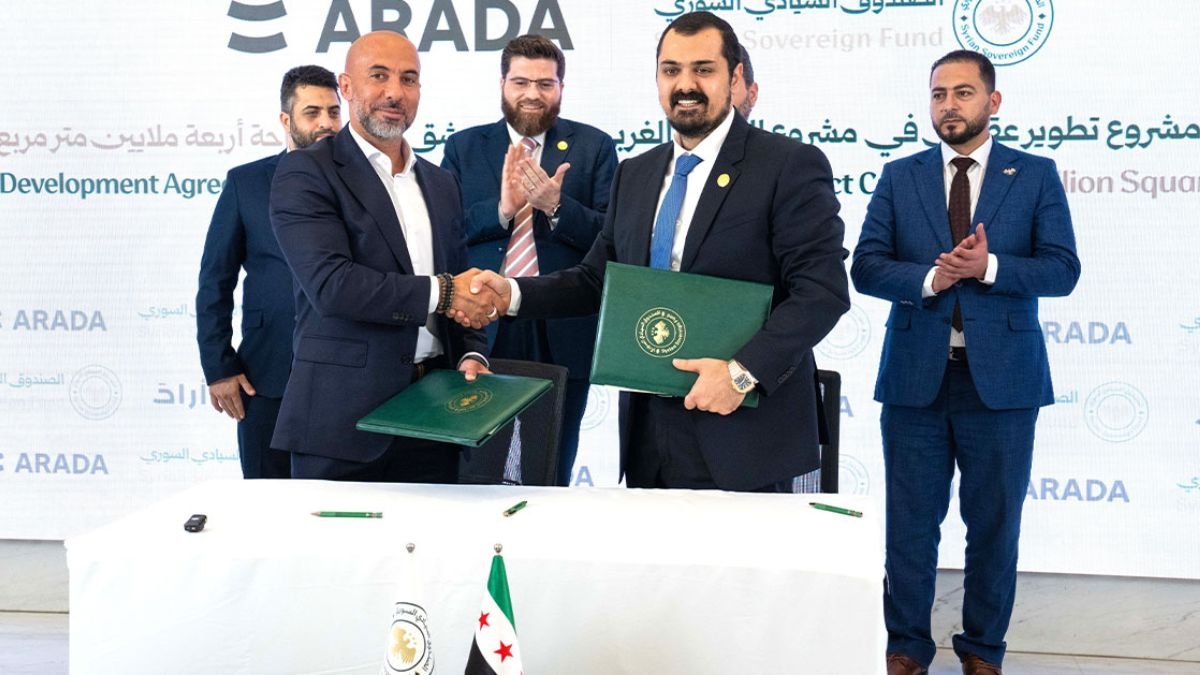
The agreement was signed at the Syrian Sovereign Fund’s headquarters in Damascus by Arada Group CEO Ahmed Alkhoshaibi and Mohammed Al Khayyat.
The signing ceremony underlined the importance attached to the project, with Syrian President Ahmed al-Sharaa also receiving Arada Group CEO Ahmed Alkhoshaibi at the People’s Palace.
Building a New Urban Destination
At four million square metres, the development is expected to be one of the largest individual foreign real estate projects announced for Syria in the current reconstruction period.
Its proposed scale means the project will function as an urban destination rather than a conventional housing scheme. The inclusion of thousands of homes alongside hotels, serviced apartments, schools, a hospital, retail, offices, public parks and government services is intended to create a self-contained community with a broad range of residential and economic activity.
The 700,000 square metre public park will represent a substantial component of the overall master plan, providing open space and recreational facilities within the wider development.
The combination of residential and commercial uses could also support a more diversified local economy, bringing together households, businesses, hospitality operators, educational institutions and healthcare services within the same development.
A Significant Test of Gulf Development Expertise
The Syria project gives Arada an opportunity to apply its experience in large-scale master development to a market undergoing significant change.
The company’s existing UAE communities, including Aljada and Masaar, have given it experience in delivering developments that combine housing with retail, leisure, hospitality and community infrastructure. The new project will draw on that experience while being developed within the specific economic, regulatory and infrastructure conditions of Syria.
For the wider Gulf property sector, the agreement is also notable because it illustrates how UAE-based developers are beginning to look beyond established Gulf markets for large-scale growth opportunities.
The participation of a UAE developer in a project of this scale could create opportunities for other companies across the Gulf’s construction, engineering, hospitality, retail and professional-services sectors if the development progresses into its implementation phases.
What Comes Next
The immediate focus will be the development of the master plan in coordination with Syrian authorities, alongside work on the wider development framework.
Arada and the Syrian Sovereign Fund are also expected to continue assessing additional sites across Syria, potentially creating a broader development relationship beyond the New Damascus project.
With a planned 11,000 homes, 500 hotel rooms, 1,000 serviced apartments, education facilities, a 300-bed hospital, commercial and office space and a major public park, the first project establishes a substantial footprint for Arada in Syria.
The $7 billion development therefore represents more than the UAE developer’s entry into a new market. It places large-scale private real estate investment, master planning and community development at the centre of a new phase of Syria’s reconstruction story, while giving Arada a potentially significant role in shaping the country’s emerging urban landscape.