


Introduction
Commercial aviation relies on far more than aircraft in the sky. Behind every safe departure is a chain of specialist engineering, disciplined maintenance, certified processes and trusted infrastructure. As global fleets expand and next-generation engines become more complex, engine maintenance, repair, overhaul, testing and aftermarket support are becoming critical priorities for airlines, lessors, OEMs and engine owners.
In the Middle East, where aviation is central to economic growth and international connectivity, the opportunity is especially significant. Regional airline growth, the development of Dubai South’s Mohammed Bin Rashid Aerospace Hub and Al Maktoum International Airport, and the UAE’s ambition to strengthen its advanced industrial base are creating demand for deeper local engine support capability.
Among the leaders working to address that need is Lawrence J. Howie, Founder, Chairman and CEO of IER MRO Industries DWC-LLC. Through IER MRO, he is leading the development of a major engine maintenance and support platform at Mohammed Bin Rashid Aerospace Hub (MBRAH), designed to support the next chapter of aviation maintenance in the region.
From Industrial Gas Turbines to Aviation Engines
Lawrence’s journey did not begin with commercial aviation. It began more than four decades ago in the industrial and aero-derivative gas turbine sector, supporting critical energy infrastructure across the UAE and wider region. That experience shaped his view of engineering leadership: reliability is never accidental; it is built through discipline, technical competence, accountability and consistent delivery.
Those principles now sit at the centre of IER MRO. The company is not being developed simply as another maintenance facility, but as an integrated engine support platform combining maintenance, module repair, testing, digital systems, inventory support and customer-focused aftermarket services. The aim is to create a capability that is rooted in the UAE but relevant to international operators and asset owners.
A Platform Built Around Scale and Capability
IER MRO’s planned development represents a significant long-term investment in the UAE’s aerospace sector. The project is centred around a 1.4 million sq ft smart factory engine MRO campus at Dubai South, with an overall investment programme of approximately USD 1.2 billion. The capability roadmap is focused on major engine families, including CFM56, LEAP, and GEnx, supported by a planned twin-engine test cell complex and a wider ecosystem of repair, inspection, logistics, and asset support activities.
The development is being approached in phases. The fast-track MRO4 phase is intended to support early activities such as engine wash and preservation, storage, borescope inspections, inductions, hospital-visit support and parts or engine trading. The larger MRO1-3 and test cell programme will build towards deeper engine overhaul, module repair, testing and support services. This phased approach reflects Lawrence’s preference for measured execution over excessive promises.
Leadership Rooted in Trust and Accountability
For Lawrence, leadership in aviation is not about making the loudest decisions. It is about making the right decisions, particularly when safety, quality and customer trust are involved.
“Safety, integrity, technical competence and accountability are standards that cannot be compromised,” he says.
That belief has guided the development of IER MRO. The project requires coordination across design, construction, regulatory planning, technical partners, equipment suppliers, digital systems and future customers. Rather than treating these as separate workstreams, Lawrence views them as interconnected parts of a single operating model. The objective is to build a facility that delivers consistently once operational, not simply looks impressive on paper.
Smart Factory, Digitalisation and AI
A defining feature of IER MRO’s strategy is its commitment to building digital capability from the beginning. Lawrence believes smarter planning, better data, traceability, predictive analytics, transparent workflows and stronger integration between people, equipment and systems will shape the next generation of engine MRO.
IER MRO is therefore being designed around a smart-factory model. Digital twins, AI-enabled workflows, data analytics, intelligent planning tools and connected operational systems are being evaluated as part of the wider design. The goal is practical: better turnaround time, stronger quality control, improved customer visibility, more efficient use of labour, and clearer decision-making across the maintenance process.
“The best use of technology is to give skilled people better information, stronger controls and more time to focus on critical work,” Lawrence says.
He is equally clear that digital systems do not replace aviation expertise. In a regulated, safety-critical industry, human judgement, technical authority and certified competence remain essential. The value of technology is that it supports those people and helps them perform with greater accuracy, speed and confidence.
Advanced Manufacturing and Repair-First Thinking
Beyond conventional maintenance, IER MRO is also exploring how advanced manufacturing, repair development, and smarter materials management can strengthen engine support capability. In aviation, the ability to repair and return high-value components to service safely can create major operational and sustainability benefits.
The company’s long-term ambition is to support a repair-first mindset, where, technically and commercially appropriate, it is always within approved regulatory and OEM frameworks. This includes developing processes and partnerships to support component repair, module-level work, tooling, inspection, inventory management, and future manufacturing-related support activities.
Engine Inventory and Asset Management
IER MRO’s strategy also recognises that modern engine support is not limited to workshop activity. Airlines, lessors and engine owners increasingly require access to spare engines, spare parts and material, inventory planning and asset-management solutions.
As part of its wider platform, IER MRO is developing an engine inventory and asset management strategy to support customers beyond the physical MRO facility. This could include engine trading, leasing support, inventory availability, and structured asset solutions that help operators manage costs, downtime, and fleet reliability. For Lawrence, this is an important part of creating a complete engine support ecosystem rather than a single-service operation.
Building Talent for the Future
Advanced buildings and digital systems can strengthen an MRO operation, but they cannot replace skilled people. Lawrence has made talent development a central part of IER MRO’s long-term plan. The planned IER MRO Training Academy is intended to support the development of technicians, engineers, inspectors, planners and future leaders across engine MRO, module repair, test cell operations, digital systems and advanced manufacturing.
This focus closely aligns with the UAE’s ambition to deepen local industrial capabilities and create high-quality technical careers. By combining international expertise with local and regional talent development, IER MRO aims to contribute to a stronger aerospace workforce for the future.
Sustainability Through Smarter Maintenance
Lawrence sees sustainability in aviation as a practical responsibility. MRO providers can make a meaningful contribution by extending the life of high-value components, reducing unnecessary material consumption, improving process efficiency and supporting better asset utilisation.
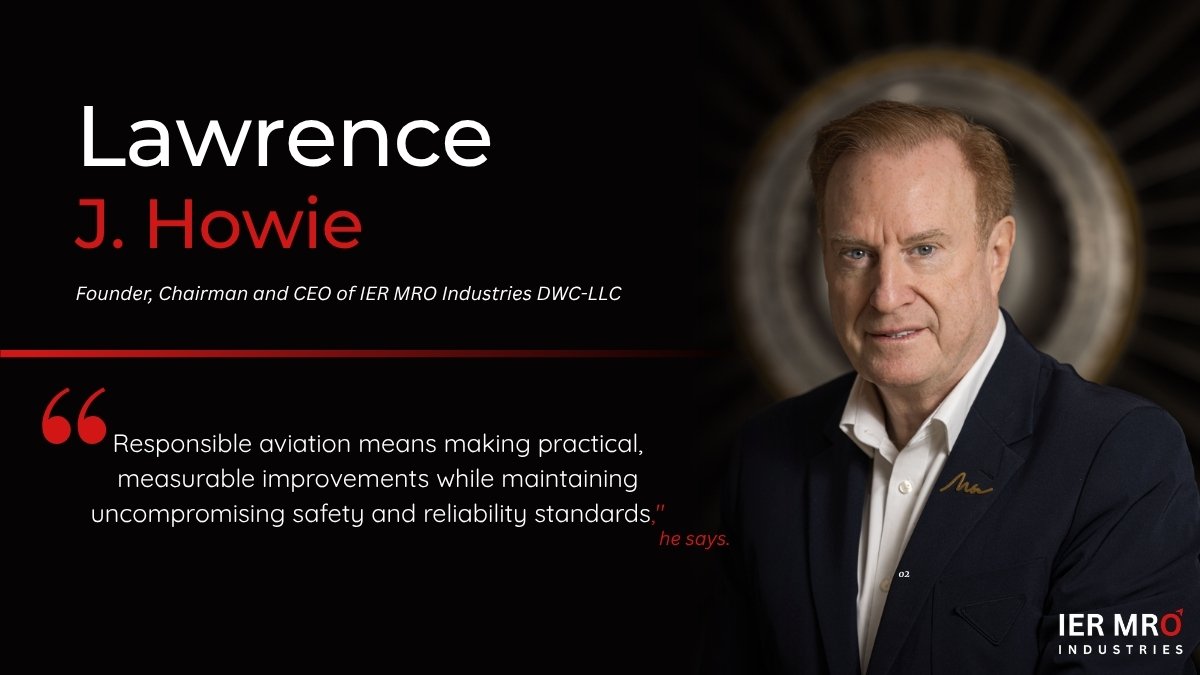
“Responsible aviation means making practical, measurable improvements while maintaining uncompromising safety and reliability standards,” he says.
For IER MRO, sustainability is therefore linked to repair capability, efficient operations, responsible materials management, energy-conscious facility design and smarter planning. It is not a slogan, but a discipline that must be built into the operating model.
A Unique Opportunity in the UAE Aerospace Sector
The UAE has become one of the world’s most important aviation hubs, supported by airlines, airports, logistics infrastructure, free zones and a strong focus on advanced industries. However, regional growth also creates a need for deeper technical support, particularly in engine MRO and related aerospace services.
IER MRO is positioned to help address that need by creating additional engine support capacity near major operators and international aviation hubs. Its location at Dubai South’s Mohammed Bin Rashid Aerospace Hub, adjacent to one of the region’s most strategically important aviation developments, provides the project with a strong foundation. More importantly, its integrated approach brings together MRO, testing, digitalisation, asset management, inventory, training, and advanced technical capabilities into a single platform.
Defining Success Through Long-Term Impact
For Lawrence, success will not be measured by announcements alone. It will be measured by the ability to operate safely, earn customer confidence, deliver consistent quality, develop people and become a respected name in global aviation maintenance.
The development of IER MRO brings together decades of industrial experience with a long-term vision for the UAE’s aerospace sector. It has the potential to create skilled employment, strengthen regional engine support capability, support airline and lessor requirements, and contribute to the UAE’s wider ambition to become a deeper centre for advanced aviation services.
“Our ambition is clear: to build a business that customers can trust, employees can be proud of, and the region can view as a meaningful contribution to the future of aviation,” Lawrence concludes.
Looking ahead, IER MRO is still at an early but important stage of its journey. Its direction is clear: to build a digitally enabled, technically disciplined and internationally relevant engine services platform that supports the next era of aviation maintenance from the UAE.

